
Section 02
Prompt Guide & Library
A vague prompt gets a vague answer. Five ingredients turn a chatbot into something closer to a useful advisor — then steal the templates below.
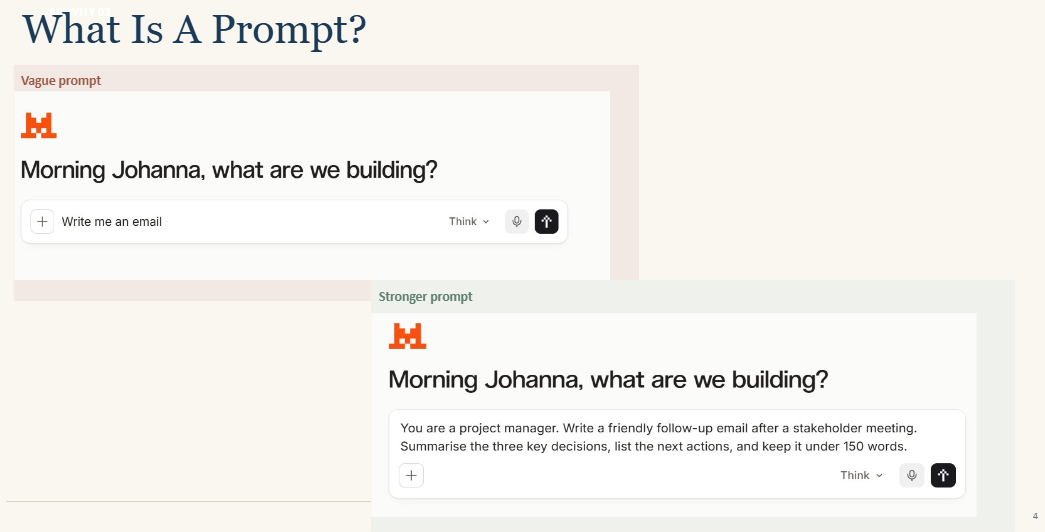
A prompt is the information, instructions and context you give an AI to guide its response.
The 5-part prompt
You don't need all five every time — but the more of them you include, the less generic the answer. Think of a as a brief you'd give a new intern.
Role — Who should the AI be?
"You are a pragmatic startup mentor who has coached teenage entrepreneurs for ten years."
Context — What does it need to know about you?
"I'm 17, building a refill station for cleaning products in Luxembourg. Budget: €200. No team yet."
Task — What exactly should it do?
"List the three riskiest assumptions in this idea and how I could test each cheaply."
Format — How should the answer look?
"A table with columns: assumption, why risky, cheapest test, time needed."
Constraints — What are the rules and limits?
"Plain English, no jargon, max 200 words. Say 'I don't know' rather than guessing figures."
One more habit: ask it to say "I don't know" instead of guessing. It won't always obey, but it helps.
Prompt library
Copy, then swap anything in [square brackets] for your own details.
Customer interview questions
You are a user researcher. I'm building [product] for [audience]. Write 10 open-ended interview questions that uncover how they solve this problem today, without mentioning my product or leading them to praise it. Format as a numbered list.
Explain a market to me
You are a patient analyst. Explain the [industry] market in Luxembourg to a 16-year-old entrepreneur: who the main players are, how they make money, and what's changing. Plain English, max 300 words. Flag clearly anything you're unsure about or that may be out of date.
Competitor teardown
Act as a competitive analyst. Here is a competitor's website text: [paste]. Summarise their positioning, target customer, pricing signals and one weakness I could exploit. Table format. Only use what's in the text — do not invent details.
Turn interview notes into insights
Here are notes from 5 customer interviews: [paste, names removed]. Identify recurring themes, surprising quotes and any theme that only one person mentioned. Do not add conclusions the notes don't support.
Stress-test my idea
You are a friendly but sceptical investor. My idea: [describe in 3 sentences]. Give me the 5 hardest questions you'd ask, and for each, what a strong answer would contain. Be direct, not discouraging.
Business model options
I sell [product] to [customer]. Suggest 4 different revenue models (e.g. one-off, subscription, freemium, B2B). For each: how it works, why it might fit, and the biggest risk for a team with no budget. Table format.
Pricing sanity check
My costs per unit are [X] and I'm considering charging [Y]. Walk me through how to sanity-check this price: what to compare, what to test with customers, and what I might be forgetting. Do not invent competitor prices.
Weekly entrepreneur plan
You are a startup coach. I have 6 hours this week and these goals: [list]. Build a realistic plan with the highest-impact tasks first, and tell me what to deliberately not do. Bullet list by day.
Pitch deck outline
You are a pitch coach for student startups. My venture: [describe]. Outline a 10-slide deck: slide title, one-sentence purpose, and the single strongest point it must land. Keep it concrete — no filler slides.
Sharpen my one-liner
Here's my elevator pitch: [paste]. Rewrite it 5 different ways, each under 20 words, each with a different angle (problem-first, customer-first, bold claim, story, contrast). Then tell me which is strongest and why.
Judge Q&A drill
Act as a jury panel at a student startup competition. Based on this pitch: [paste], ask me 8 questions one at a time, wait for my answer, then rate it out of 5 with one improvement each time.
Demo day story
Help me open my pitch with a 30-second true story about why I started this: [give the raw details]. Keep my voice, no corporate clichés, no exaggerated claims. Give me 3 versions.
Did I actually think?
I used AI to produce this: [paste]. Play devil's advocate: what did I likely not consider, what claims here need a source, and which parts sound generic rather than specific to my business?
Where AI is helping vs. hiding
Here's how I used AI this week: [list tasks]. Which of these saved me time on the boring parts, and which might be replacing skills I should be building at this stage of my journey? Be honest.
Team retro helper
You are a facilitator. Our team of [n] just finished [milestone]. Give me 6 retro questions that surface what went wrong without blaming anyone, plus how to run the session in 30 minutes.
Values check on an output
Here's a marketing message I drafted with AI: [paste]. Does it overstate anything, pressure the reader, or claim results we can't prove? Rewrite it so it's honest and still persuasive.